
Choose a competent local framework
Ask about open roles, training, supervision and referral routes for legal, social or medical questions. A structured group prevents contradictory advice and dependence on one contact.
Start with the request
Needs and priorities differ. Ask open questions, accept refusal and agree on one realistic objective instead of assuming what a person needs.
Set clear boundaries
State availability, contact channels, duration and limits. Refer specialist matters and never lend an address, account, document or signature without understanding the consequences.
Build a dignified relationship
Keep family, status, address and health information private. Review usefulness with the person and organization and end or change the role cleanly when needed.
A missing relative: supported tracing
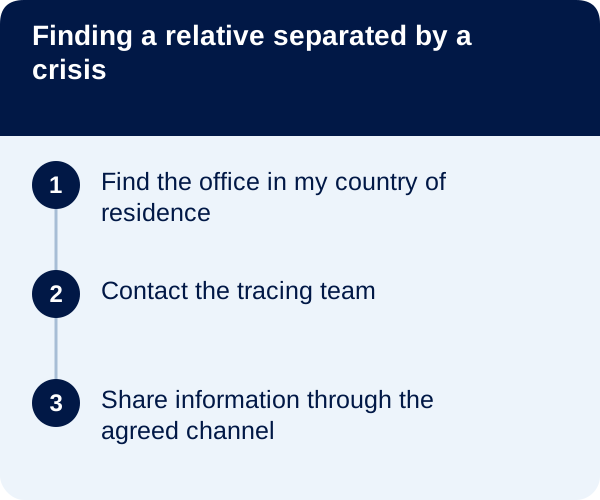
The Restoring Family Links network helps families who have lost contact because of conflict, disaster or migration. Start with the Red Cross or Red Crescent office in the country where you currently live, even if your relative is elsewhere. The service is free.
The team collects information needed for tracing and explains how it will be shared with your consent. Use this confidential route instead of posting names, documents or travel routes on social media. A search does not guarantee that someone will be found, family reunification or immigration status. A person’s decision not to resume contact must be respected.
ICRC — Restoring Family Links · Official source ·
Help with a form without copying the entire file
Illustrative fictional scenario: Someone asks for help understanding a form. Several volunteers suggest photographing documents and sharing them in a group. Easier coordination can expose an address, family circumstances or administrative status to people who do not need it.
Clarify the requested help and your role before opening the file. Use the organization’s designated channel, share only what is necessary and explain who will have access. Refer legal interpretation to a qualified service. Let the person confirm information, avoid automatic copies on your phone and arrange a handover with their agreement.
ICRC — Data protection in humanitarian action · Official source ·
Support a procedure without taking over decisions
Helping someone read a form does not authorize you to choose answers or sign. Agree what support is wanted, let the person review the information and distinguish translation, administrative help and specialist advice.
- Understanding: invite an explanation in their own words.
- Decision: let the person confirm their answers.
- Referral: identify the relevant professional.
A bilingual relative is not automatically a suitable interpreter for every sensitive situation.
UNHCR · Help · Official source ·
Begin local support in 6 steps
- 1
Find a local structure
Check mission, supervision and contact.
- 2
Define your contribution
State skills, languages, time and limits.
- 3
Complete induction
Understand confidentiality and safeguarding.
- 4
Listen to the request
Agree on an objective without assuming it.
- 5
Refer correctly
Use professionals for specialist matters.
- 6
Review the role
Assess usefulness, workload and next steps.
Practices to avoid
- Promising an administrative result, housing or a job.
- Requesting a personal story out of curiosity.
- Sharing a photo, name or situation without informed agreement.
- Becoming the only intermediary or emergency contact.
- Giving legal or medical advice outside your competence.
Frequently asked questions
Do I need another language?
Not always. Logistics, orientation, activities, mentoring and digital support may need different skills.
Can I help without an organization?
Informal support is possible, but a reliable local framework adds referral, supervision, continuity and protection.
How do I protect privacy?
Collect only what the role needs, use approved systems and never share the situation with third parties.
What if a request is outside my role?
Explain the limit and contact the designated coordinator; use local emergency services for immediate danger.
Official sources
Always verify the date and conditions on the official source.
Organisations and resources to explore
These examples relate to the topic through their documented activities. They are neither a ranking nor a guarantee of availability; check each organisation’s terms and requirements.

Jesuit Refugee Service
JRS supports displaced people through education, economic inclusion, psychosocial support, reconciliation and advocacy. Its programmes address several complementary needs of refugees.
View directory record →
Norwegian Refugee Council
NRC supports people forced to flee and protects their rights. Documented activities include education, shelter, information and legal assistance, protection from violence, livelihoods, food security, water and hygiene. Country programmes specify the services and populations concerned.
ICLA: targeted legal support
ICLA covers housing, land and property, legal identity, residency, internal displacement registration, employment law and access to essential services. One problem can therefore involve several areas.
The global description guarantees neither a local service nor acceptance of a case; check the relevant country operation.

International Refugee Assistance Project
IRAP combines legal services, information resources, litigation and advocacy for displaced people, including access to lawful pathways to safety.
View directory record →
La Cimade
La Cimade directs foreign nationals and those supporting them to regional and local teams for procedures and contacts suited to their difficulties.
View directory record →
France terre d’asile
The Paris first-reception service describes its mailing-address support and its social, administrative and legal guidance. Consult the official page for eligibility and referral arrangements.
View directory record →