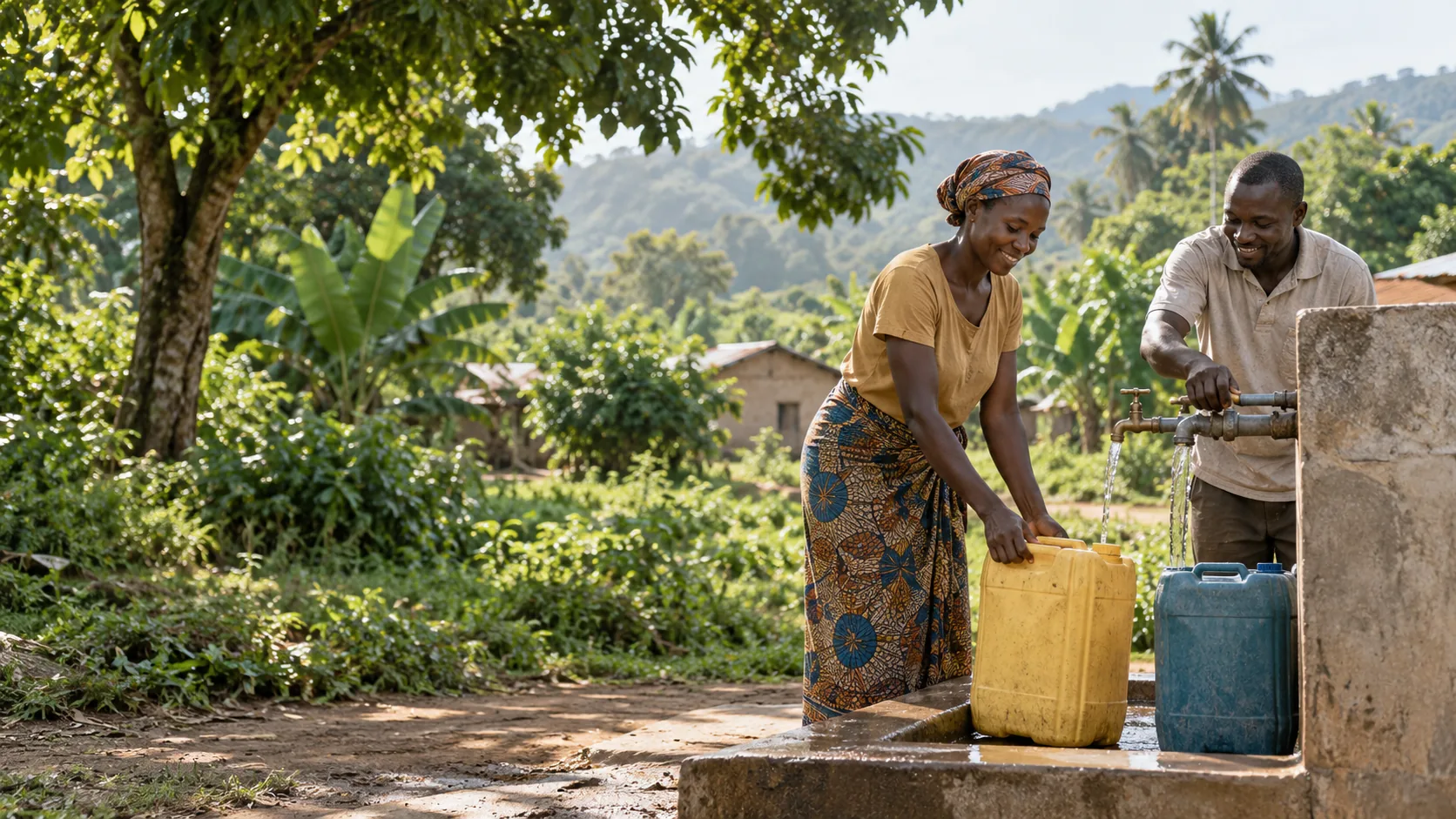
Two people fill containers at a water point. Water access also depends on distance and maintenance.
Fictional illustrative scene
Understand the assistance pathway
Food assistance considers nutritional needs, habits, markets and cooking facilities. Water and hygiene also affect food use. Distributions, cash transfers and support for local suppliers address different constraints.
Compare approaches and constraints
Water projects involve more than building an installation. Examine seasonal availability, journeys, accessibility, quality checks and maintenance. Ask who repairs faults, funds consumables and receives user reports.
Read results and limitations
Indicators can describe a functioning service, quality, use and interruptions. Wells or parcels do not express all these aspects. Compare the same area and period, and examine coverage gaps and user feedback.
A practical question
Can access to water be measured by the number of wells built?
This counts infrastructure, not necessarily water quality, breakdowns, journeys, costs or accessibility. Monitoring needs to examine the usable service over time.
Choose an appropriate response
Food assistance, cash transfers and water-system repairs address different barriers. Cash needs usable markets; goods need distribution; infrastructure needs maintenance and responsibility after installation.
See whether affected people help choose the response, water quality is monitored and infants and at-risk groups are considered.
Questions to ask
- How are food needs and market access assessed?
- Who checks water and maintains facilities?
- Does aid reach people unable to queue or travel?
Check the whole journey to a service
UNICEF guidance addresses disability inclusion in protection, water and hygiene, education, health and nutrition. Adapting only a building entrance leaves out understanding information, reaching the site, using equipment and being able to request a change.
When examining a project, ask how children and adults with disabilities participate in preparedness, monitoring and recovery. An accessible water point must also be reachable and usable; information needs to be available in a form its intended users understand.
UNICEF — Including children with disabilities in humanitarian action ·
Read this programme’s follow-up
Food and water support needs monitoring across seasons and actual access. One delivery can hide interruptions between visits.
- Service continuity during the reporting period.
- Access for remote or less mobile households.
- Feedback on use and barriers experienced.
Distributed goods alone do not establish nutritional improvement.
Documented programmes
These examples relate to the topic through their documented activities. They are neither a ranking nor a guarantee of availability; check each organisation’s terms and requirements.
WaterAid
WaterAid works with communities and partners on clean water, toilets and hygiene. Its approach includes sustainable systems, sharing practices and influencing decision makers, extending beyond installing equipment to the long-term functioning of services. In programme results, distinguish installed equipment, a functioning service and sustained use. Check period and indicator definition before comparing figures; installation counts alone do not describe people actually served.
View directory record →
Water.org
Water.org helps households access water and sanitation through financing, including small loans. This approach distinguishes access to finance from direct provision of infrastructure.
View directory record →
Action contre la Faim
Action contre la Faim describes an approach connecting nutrition and health, food security and livelihoods, water and hygiene, mental health and psychosocial support. Advocacy, climate and research complement these areas, addressing causes of hunger and living conditions beyond food distribution.
View directory record →
Les Restos du Cœur
Les Restos du Cœur combines food assistance with wider support, including housing access, employment integration and help for children and families.
View directory record →
GlobalMedic
GlobalMedic mobilizes professionals and volunteers for emergency aid. Its areas include water, food, medical assistance, shelter, flooding and the RescUAV programme.
View directory record →
Ação da Cidadania
In Brazil, Rede Alimentação Solidária brings together food banks, pantries and community kitchens. Its documentation distinguishes their roles from food collection to the distribution of ready-to-eat meals.
View directory record →Official sources
Inclusion is informational, not certification. Tags describe broad fields and do not verify an active programme in a particular area.