
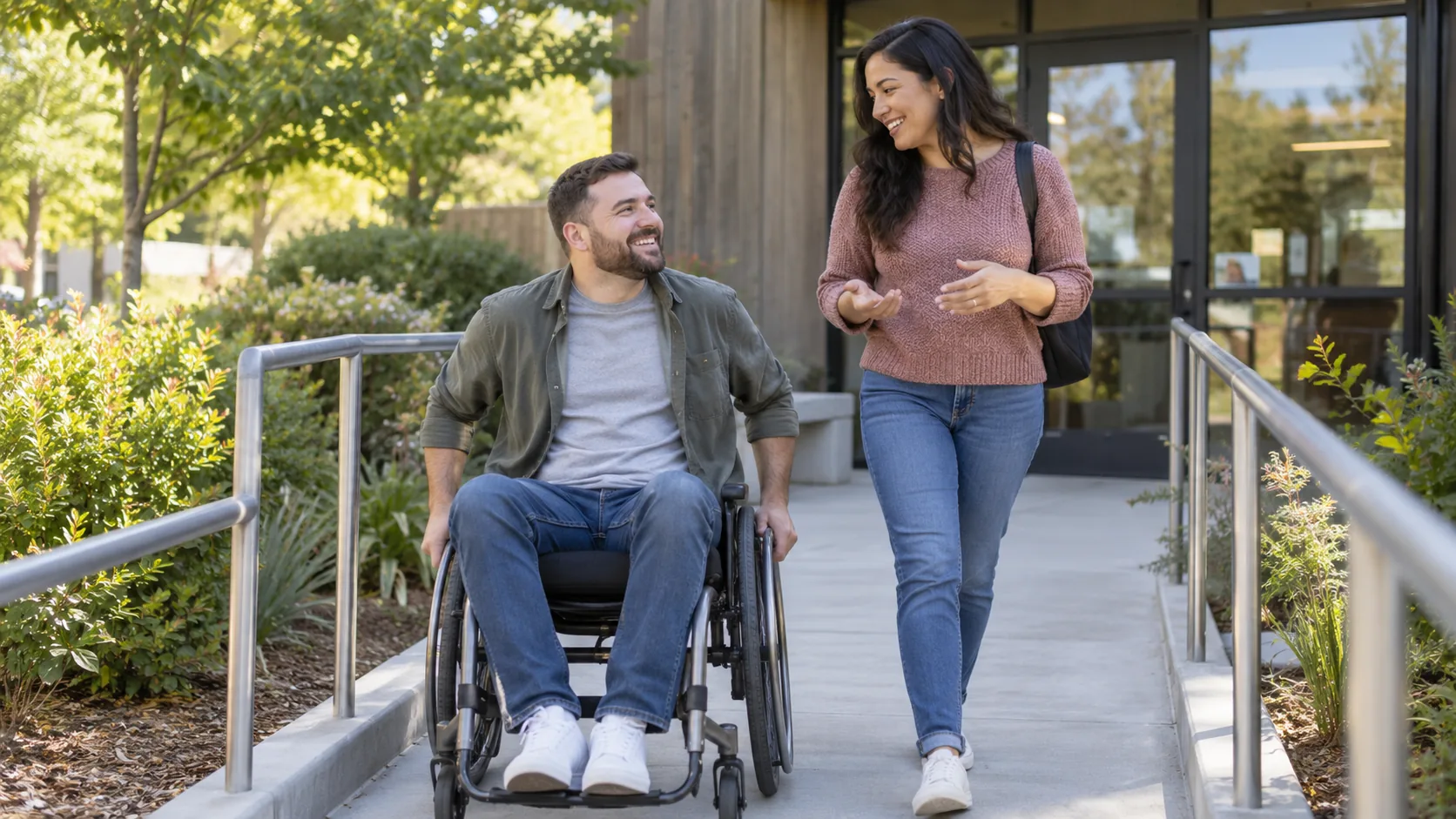
A wheelchair user takes an accessible ramp while talking with another person. Equipment and an accessible environment complement each other.
Fictional illustrative scene
Understand the assistance pathway
Inclusion covers finding information, travelling, understanding guidance, using a service and giving feedback. A ramp is one element. Representative organizations and affected people can identify barriers teams have missed.
Compare approaches and constraints
Compare physical access, interpretation, readable information, transport, hours and chosen support. Assistive devices need individual adaptation and maintenance. Do not assume relatives can consent or speak for a person; examine participation arrangements.
Read results and limitations
Results may show who remains excluded, which barriers were removed and whether complaints are accessible. Group data should be proportionate and protected. Equipment counts do not establish participation in education, work or community life.
A practical question
Is a physically accessible service necessarily inclusive?
No. Language, information, costs, transport, communication and attitudes may still create barriers. Inclusion is checked with affected people through actual service use and feedback.
Choose an appropriate response
Ramps, translation and personal assistance address different barriers. Accessible services also consider travel, waiting, cost, information formats and personal choice. Affected people should participate in decisions.
Look for accessible formats, consultation with affected people and complaint routes that do not rely on one channel.
Questions to ask
- Which barriers were identified with affected people?
- Are several contact formats and channels available?
- Does assistance respect autonomy and consent?
Official sources
Inclusion is informational, not certification. Tags describe broad fields and do not verify an active programme in a particular area.